
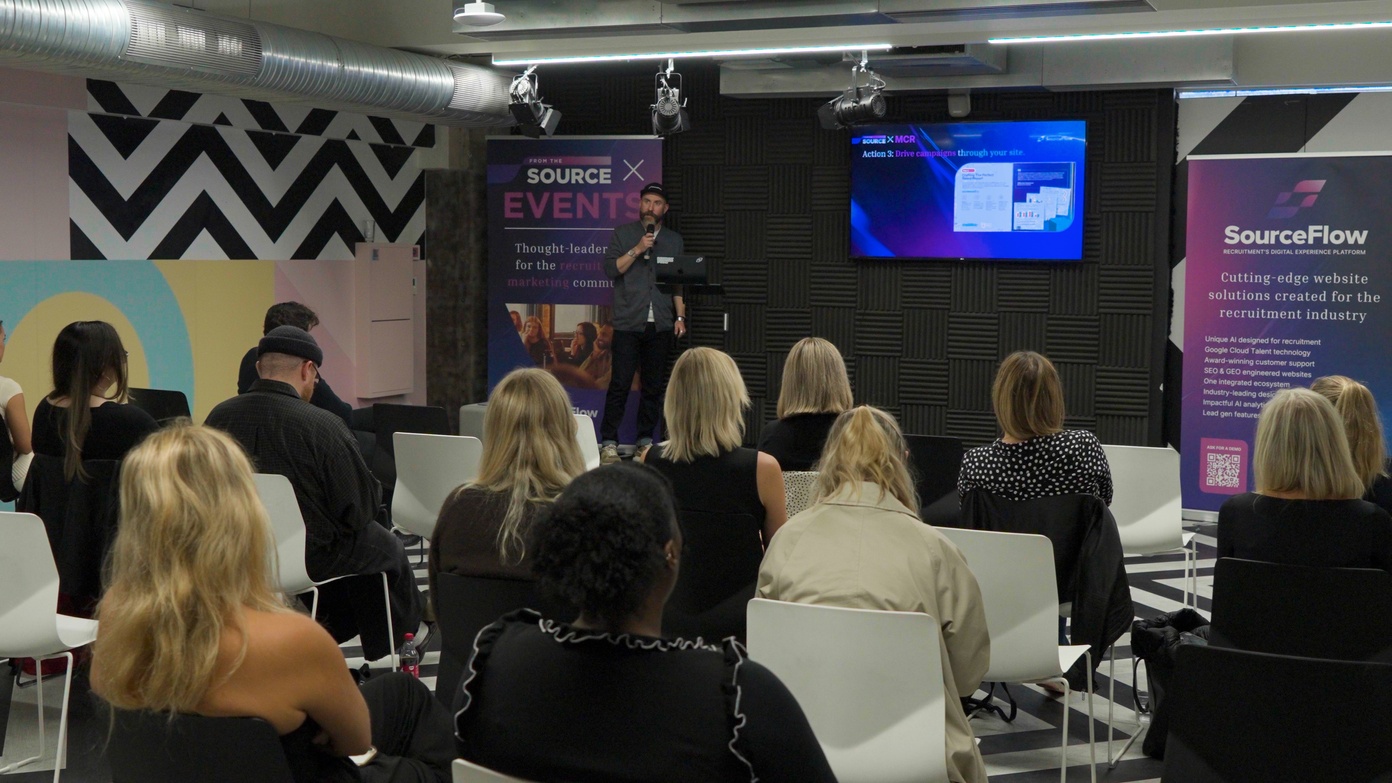
AI is changing how candidates and clients find recruitment agencies. Will Astbury explains how to improve search visibility, put consultant expertise to work and turn website content into leads.
This article is part of our From The Source X MCR series, following our event at Huckletree Ancoats on 30 September 2026.
At our From The Source event in Manchester, I asked the room who understood the difference between SEO, AEO and GEO.
Not many hands went up. With three acronyms flying around, I can understand why.
But if you’re responsible for generating leads from a recruitment website, the difference matters more than it used to.
SEO, AEO and GEO: What's the difference?
Here's how I'd explain them:
-
SEO (Search Engine Optimisation): Improving your website's visibility in traditional search results.
-
AEO (Answer Engine Optimisation): Structuring content so search tools can use it to answer questions.
-
GEO (Generative Engine Optimisation): Helping generative AI platforms understand and reference your content in their responses.
The difference is where your content appears. With SEO, you’re trying to rank in search results. With AEO and GEO, you’re also trying to get your content included in the answers people receive.
The fundamentals overlap. Your website needs a clear structure, content that answers relevant questions and evidence of the expertise behind it.
What’s changed is how much harder it’s become to get seen at all.
Why are recruitment websites harder to rank than they used to be?
Since Google introduced AI Overviews, organic traffic has reportedly dropped by 30 to 40% for many websites. Around 20% of searches now show an AI-generated summary.
Even if you rank first for a valuable keyword, AI Overviews and sponsored listings can push your website further down the page.
And many recruitment websites are already struggling. SourceFlow's analysis found that 70% failed SEO performance benchmarks, with poor site structure, missing information and inconsistent content contributing to the problem.
But don't abandon Google for ChatGPT. Google handles around 14 billion searches a day, compared with ChatGPT's reported 2.5 billion daily prompts. You need visibility across both.
During my Manchester talk, I searched ChatGPT for marketing jobs in the city. A SourceFlow client's vacancies appeared in the response, despite me never mentioning the agency.
It was a boutique recruitment business competing for visibility alongside much larger agencies.
That's the opportunity: make your jobs, specialisms and market expertise easy for search platforms to find and understand.
Why isn’t your recruitment website generating leads?
I regularly hear agencies say, “We get nothing from our website.”
In most cases, they’re not wrong. If you’re not doing the right things on your website, you will absolutely get nothing from it.
Give every page a clear purpose. A cybersecurity recruitment page should explain your expertise, answer relevant hiring questions and direct visitors towards jobs or an enquiry.
Check the structure:
-
H1: One clear main heading that describes the page.
-
H2s: Headings organised around relevant topics and questions.
-
Metadata: Unique page titles and descriptions.
-
Content: Useful information with a clear next step.
Make it easy for search engines to understand what you do, and for visitors to act on it.
Your consultants are an SEO asset. Use them.
Google’s E-E-A-T framework covers experience, expertise, authoritativeness and trustworthiness.
Recruitment consultants spend their days speaking to candidates and hiring managers. They know which skills are in demand, what employers are paying and where hiring processes are breaking down.
Get that knowledge onto your site.
If your consultants have got a good personal brand, get them to be the authors of the articles on your website.
Ask a cybersecurity consultant to write about hiring challenges in their market. Add their name, biography and LinkedIn profile. Encourage them to share the article with their network.
Now you’ve got content connected to someone with relevant experience and an established professional presence. Google wants evidence that the people producing your content know what they’re talking about.
Show it.
Your website needs to load quickly and work for everyone
The longer your pages take to load, the more likely visitors are to leave. Google considers a page load time 2.5 seconds or less to be good.
Start with Google PageSpeed Insights. Compress images, use modern file formats and stop stacking animations that slow everything down. As a practical rule, keep ordinary images under 100kB where quality allows.
Speed is only part of the experience. If people can't navigate or use your website, you're losing potential candidates and clients.
Around 69% of disabled users leave a website when they encounter an accessibility barrier, while accessible sites reportedly earn 30% more revenue from digital channels.
Check keyboard navigation, text contrast and image alt text. Use Recite Me to identify accessibility issues.
Our recruitment website accessibility playbook covers the checks in more detail.
Make consistent content production part of the job
When I worked in recruitment marketing, I introduced content targets into my team’s bonus scheme. We aimed to produce four to six articles a month to support our SEO strategy.
That meant agreeing what we would publish, assigning responsibility and making content production part of our objectives.
A content calendar should cover articles, case studies, market reports and events. Your targets should reflect the size of your team and the markets you’re trying to reach.
I’ve explained the approach in how bonus schemes have been responsible for my success. Our 2026 incentivisation report also includes a template based on the scheme I ran.
Salary reports can generate leads for months
Around 19,000 searches a month in the UK relate to salary information. I’ve generated thousands of leads through salary-report campaigns during my recruitment marketing career.
At Harvey Nash, our CIO survey campaign involved months of research and kept supporting client conversations long after publication.
At Oscar, we connected report download forms to our CRM and asked one question:
Why are you downloading this report?
Someone researching their next salary could be a candidate. Someone benchmarking salaries for a new team could be a client. We used those answers, alongside job titles and sectors, to route enquiries to the right consultants.
Should you gate the report?
That form is worth having. Just don’t let the gated version be the only version.
A report locked behind a download form gives search engines very little to work with. Publish articles using the research, answer relevant salary questions on your website and link to the full report.
You keep the lead capture while giving your research a chance to appear in search results.
Plan the campaign in three stages:
-
Before publication: Gather data from candidates and clients, creating opportunities for consultants to start conversations.
-
At launch: Promote the findings through articles, email campaigns, LinkedIn and events.
-
After launch: Use CRM data and marketing automation to follow up with relevant contacts.
Our salary report lead magnet playbook explains how to plan and promote these campaigns.
Where to start
If you want something to do tomorrow, start with three:
-
Page speed: Run your most important pages through Google PageSpeed Insights.
-
Accessibility: Scan your site with Recite Me and prioritise the barriers it identifies.
-
Alt text: Give informative images meaningful descriptions and mark decorative images appropriately.\
Fix a couple of those and you’ll already perform better.
Then take on the bigger work: page structure, consultant author profiles and a content calendar you keep to.
And measure it. If you’re producing salary reports, find out who’s downloading them and why. If you’re publishing specialist content, track the enquiries it brings in. That’s how you show what your website contributes to the business.
Want more advice from From The Source X MCR?
Read our event round-up for more insights on recruitment marketing, lead generation and commercial growth.
About Will Astbury
Will Astbury is Global VP of Growth at SourceFlow. Before joining SourceFlow, he spent nearly ten years working in recruitment marketing, progressing from Marketing Administrator to Global Marketing Director within specialist tech recruitment businesses.