What Recruitment Leaders Expect From Marketing In 2026
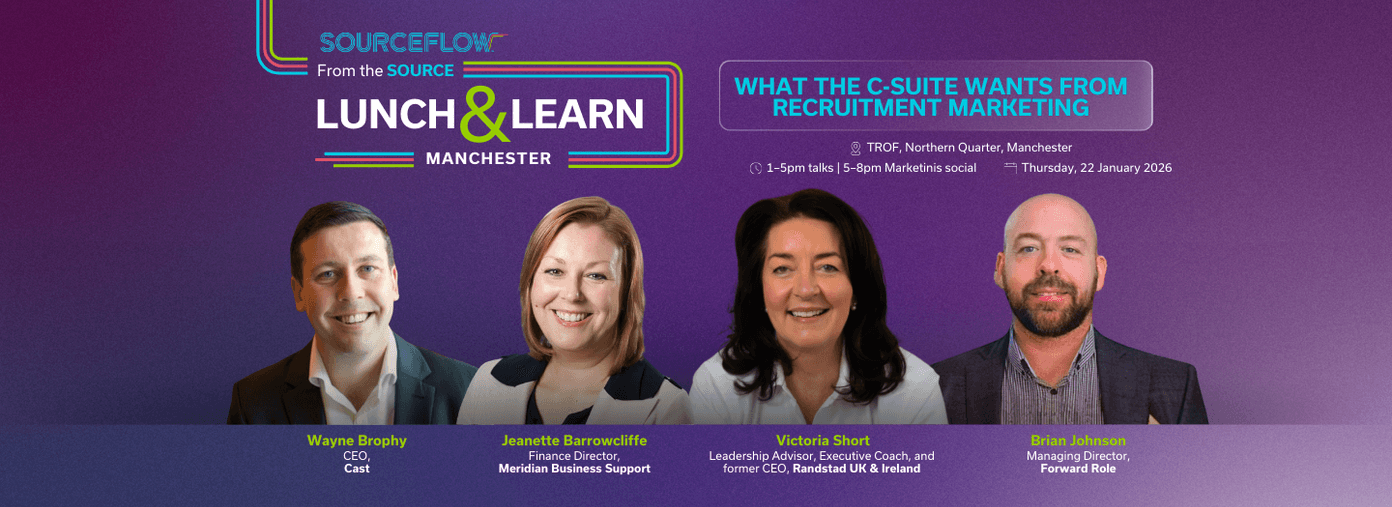
SourceFlow’s From The Source x Manchester Lunch & Learn event brought together recruitment marketers and growth-focused leaders in the city’s Northern Quarter for an afternoon of speaker sessions and a leadership panel examining how recruitment marketing is assessed in terms of cost, contribution, and commercial impact.
If you’ve followed SourceFlow’s work on marketing maturity, including From metrics to multiples: how recruitment marketing is growing up, this session explored similar themes through live discussion with practitioners and leaders.
Key Takeaways from From The Source x Manchester
-
Recruitment marketing is being judged on commercial contribution, including cost, return, and impact on revenue, not just activity metrics.
-
Marketing is most effective when sales and marketing are aligned around shared outcomes, particularly where activity links directly to revenue.
-
Access to CRM and performance data is essential for recruitment marketers. It enables them to identify gaps, support consultants, and contribute more directly to business outcomes.
-
Clear expectations, defined payback periods, and honest review points help marketing earn trust with finance and leadership teams.
-
Alignment improves when marketing understands how consultants and leadership teams operate day to day, not just when delivering output.
Aligning sales and marketing around one operating system

Ben Browning, Revenue Architect and Founder at recruitment sales coaching firm Be Resonant, works with recruitment organisations to align sales, marketing, and leadership around clear operating systems that drive predictable growth.
Ben’s session addressed a familiar problem in recruitment businesses where sales and marketing work hard, but not always in step.
He pushed back on the idea that growth comes from more BD activity alone. Instead, he set out the case for a single revenue operating system, one where sales and marketing are aligned around shared priorities, campaigns, and outcomes. He advocated for marketing being the drivers of account based sales methodology.
Rather than running parallel efforts, Ben argued that teams perform better when they work from the same structure and language. That alignment creates consistency, makes performance easier to assess, and reduces wasted effort.
Marketing has more impact when it is embedded in how revenue is generated, rather than a separate layer added on afterwards.
Why storytelling still matters in recruitment marketing

Jenny Wood is Global Head of Marketing at global marketing and tech recruitment agency Salt.
Jenny’s session focused on storytelling and its role in helping recruitment brands stay clear and recognisable as identikit AI-generated content becomes more widespread.
The strongest recruitment brands are clear on who they are, who they work with, and what problem they help solve, and they communicate that consistently.
Jenny talked through how simple narrative principles help brands stay recognisable and credible, especially in a market where content is increasingly automated. When messaging is grounded in relevance and emotional truth, it supports both attraction and conversion.
Used properly, storytelling strengthens commercial outcomes by making brands easier to understand and easier to choose.
Measuring marketing in pounds, not impressions

Kris Holland is Founder at recruitment marketing agency Kitto and spent many years as a marketing and rev-ops director within recruitment agencies.
Kris’s session focused on attribution, measurement, and how marketing builds credibility with the business.
He explained how recruitment marketers can link activity to outcomes such as meetings, vacancies, and placements, even when CRM and ATS data is imperfect. More than achieving perfect attribution, the value is in using data consistently enough to support decisions and conversations with leadership.
Kris also stressed the importance of shared language between marketing, finance, and leadership teams. Marketing becomes more influential when results are explained in commercial terms rather than engagement metrics alone.
Measurement does not need to be flawless, but it does need to reflect how the business makes money.
What the c-suite really wants from recruitment marketing in 2026
The following takeaways are drawn from the leadership panel discussion on how recruitment marketing is assessed at C-suite level.
Marketing needs to show cost, return, and payback

Jeanette Barrowcliffe is Finance Director at Meridian Business Support, an environment, healthcare, industrial, and office professional recruitment firm. She brings more than 25 years of financial leadership experience.
Jeanette focused on the importance of understanding total cost and reviewing activity against what it delivers. That might be short-term outcomes such as candidates or vacancies, or longer-term brand impact, depending on the activity.
She also stressed that different initiatives need different payback periods, but those expectations should be clear from the start. Marketing activity should be reviewed honestly and stopped if it is not delivering what was agreed.
Plan activity with defined measures and communicate results in commercial terms.
Marketing works best when it supports revenue, not just visibility

Wayne Brophy is CEO at Cast, an operational and supply-chain recruitment company he founded more than 20 years ago.
Wayne explained how marketing operates inside his business and why it is treated as a revenue-generating function.
At Cast, marketing is measured primarily on inbound enquiries that convert into vacancies. Other metrics are secondary. This focus helps align marketing and sales around shared outcomes and reduces debate about priorities.
He also described how marketing-led vacancies are recognised through fee splits. This has changed how consultants view marketing and encouraged closer collaboration between teams.
When marketing is clearly linked to revenue, it gains credibility across the business.
Access to CRM data changes the role marketing can play

Brian Johnson is Managing Director at Forward Role, a specialist technology, marketing, and digital recruitment agency he co-founded 12 years ago.
Brian explained how marketing’s influence increases when it has access to CRM data and is involved in commercial discussions.
At Forward Role, marketing works closely with client activity, follow-up, and communication gaps. This allows the team to identify missed opportunities, re-engage dormant relationships, and support consultants with more targeted insight.
By using CRM data to highlight what is not happening, as well as what is, marketing becomes part of performance improvement rather than just promotion.
Proximity to data enables marketing to contribute more directly to business outcomes.
Personalisation depends on data quality and shared ownership

Victoria Short is a Leadership Advisor, Executive Coach and the Former CEO Randstad UK & Ireland, where she spent more than 15 years of her 30-year career.
Victoria focused on the relationship between data quality and effective marketing. She explained that automation without clean data often results in irrelevant communication and missed signals. Marketing cannot solve this alone and needs to work with operations and consultants to improve how data is captured and maintained.
She also discussed marketing’s role across the full customer journey, including retention and re-engagement, not just acquisition.
Marketing adds value when it helps the business understand buying behaviour and respond in ways that remain relevant over time.
Quick Wins from The Panel
Alignment depends on understanding how the business operates.
Marketing is more effective when it understands commercial pressures, consultant workflows, and where performance breaks down. Focusing on output alone makes it harder to build trust.
Visible progress matters.
Small, practical improvements help demonstrate value and make it easier to bring consultants and leadership with you.
Marketing is judged on outcomes.
Leaders are less interested in volume of activity and more focused on results such as inbound vacancies, client retention, and contribution to revenue.
Commercial relevance affects influence.
Teams that can link marketing activity to these outcomes are more likely to shape decisions. Those that cannot risk being sidelined.
What’s next?
From The Source x Manchester sparked the kind of conversations we don’t get enough of. Honest discussion about where recruitment marketing adds value, where it falls short, and how expectations from leadership are changing.
We’re looking forward to continuing those conversations throughout the year, bringing together the brightest minds in the industry, willing to share what they’re learning along the way.
If you’d like to stay connected with future events and conversations, you can join the Recruitment Marketinis community or look out for the next Lunch & Learn announcement.
You can check out the slides from the event by clicking here.